🔥 20% OFF men's, women's and kids' jackets 🎯 Code: JACKET20 | Valid on full-price items only.

- Home
- Weapons
- Replicas
- Airsoft
- Bows
- Crossbows
- Optics
 Riflescope
- Variable Magnification
- Fixed Magnification
- Riflescopes with Parallax
- Riflescopes without Parallax
- Riflescopes for Airguns
- Hunting Riflescopes
- Driven Hunt Riflescopes
- Riflescopes for Rimfire Rifles
- Illuminated Riflescopes
- Non-Illuminated Riflescopes
- Riflescopes with mounts
- Riflescopes without mounts
- Riflescopes for airsoft
- By Parameters (Magnification × Diameter)
- Riflescope mounts
- Accessories for riflescopes
 Binoculars
- Monoculars
 Scope mounts and rings
 Reflex Sights
 Crossbow scope
- Self-defense
- Outdoor
- Clothes
- Brands


























Benefits

Authorised dealer

Brick-and-mortar store

Registration with discount

SAEC safe shopping

Fast delivery

Verified by customers
View Full-Size Image
Promotion

Mgr. František Gajdoš - technical support, weapons and ammunition specialist
eshop@afg.sk
T: +421 38 749 9230
M: +421 917 961 386
Martin Lobotka - technical support, bows and crossbows specialist
sales@afg.sk
T: +421 38 749 9230
M: +421 917 961 386
Martin Lobotka - complaints and service
reklamacie@afg.sk
T: +421 38 749 9230
M: +421 917 961 386
Last piece. Soon sold out!
Last
2
pieces. Soon sold out!
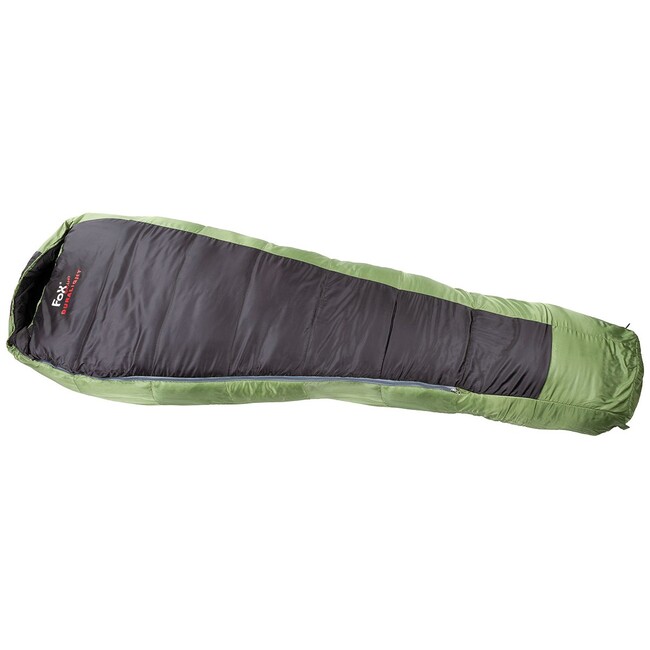
Sleeping bag Duralight, green-black
Manufacturer:
Fox outdoor
Brand:
Fox Outdoor
SKU:MF182
Catalog number:
31512M
EAN:
4044633118936
Stock position:
SKLAD 10
Guarantee:
2 years
In Stock: 2
Availability
In Stock: 2
Availability: in stock
:
Save: 16 %
Your price: 59,78€
71,09€
B2B
Size table
Sale from 18 years
This product will be sent in case of proving the age of 18.
Sale from 21 years
This product will be sent in case of proving the age of 21.
Legal guarantee 2 years (EU notice)
Show information

Benefits
Authorised dealer
Brick-and-mortar store
Registration with discount
SAEC safe shopping
Fast delivery
Verified by customers
You can also find similar products here:
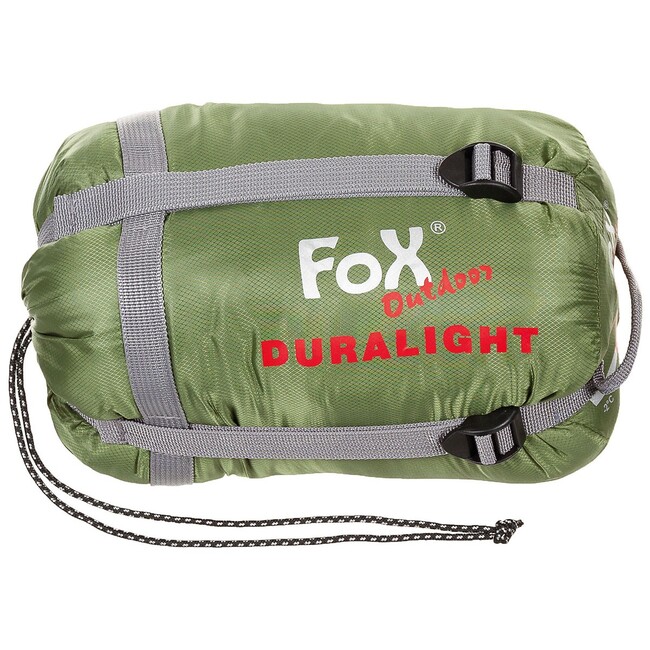
Sleeping bag model Duralight is suitable for colder season with temperatures ranging from +2°C to +18°C. It is equipped with a two-way zipper (also secured with a Velcro) so that the sleeping bag can also be used as a blanket. The hood-shaped head and shoulder area has drawstring fastenings. The package also includes a transport case with four drawstring straps. The dimensions of the package are 30 x 15 x 15 cm. The dimensions of the unfolded sleeping bag are 220 x 75 / 32 cm.
Materials used:
- Outer material: 100 % Polyester (300T Micro Diamond Rip Stop).
- Lining: 100 % Polyester (290T/50D Soft Microfibre)
- Filling: 100 % Polyester (150 g/m² Dural Downlike 3D Microfibre)
- Sleeping bag Duralight, green-black
- Manufacturer: MFH
- Package dimensions: 30 x 15 x 15 cm
- Dimensions of sleeping bag: 220 x 75 / 32 cm
- Suitable for temperatures: +2°C to +18°C
- Weight: 900 g
- Outer material: 100 % Polyester (300T Micro Diamond Rip Stop)
- Lining: 100 % Polyester (290T/50D Soft Microfibre)
- Filling: 100 % Polyester (150 g/m² Dural Downlike 3D Microfibre)
Storage of sleeping bags
The compression sleeve is for transport only, it is not suitable for long-term storage. Do not store the sleeping bag in it at home, it needs to breathe and therefore needs to be unfolded.
Store the sleeping bag unfolded (e.g. in the storage compartment of the bed, in a non-compression storage container - some bags are sold with such a container, which also serves as a dust cover). Some sleeping bags also have loops that you can hang it by, e.g. on a hanger.
Store the sleeping bag in a dry, well-ventilated place, out of sunlight. Watch out for attics and cellars where the temperature or humidity may be higher.
If you have a sleeping bag filled with feathers or down, keep it dry and ventilate it frequently.
Mgr. František Gajdoš - technical support, weapons and ammunition specialist
eshop@afg.sk
T: +421 38 749 9230
M: +421 917 961 386
Martin Lobotka - technical support, bows and crossbows specialist
sales@afg.sk
T: +421 38 749 9230
M: +421 917 961 386
Martin Lobotka - complaints and service
reklamacie@afg.sk
T: +421 38 749 9230
M: +421 917 961 386
Products Comparison
Products Comparison
No products to compare.
Mgr. František Gajdoš - technical support, weapons and ammunition specialist
eshop@afg.sk
T: +421 38 749 9230
M: +421 917 961 386
Martin Lobotka - technical support, bows and crossbows specialist
sales@afg.sk
T: +421 38 749 9230
M: +421 917 961 386
Martin Lobotka - complaints and service
reklamacie@afg.sk
T: +421 38 749 9230
M: +421 917 961 386


We recommend



Add new comment
Add reply to comment: