If you are not experienced in the field of firearms and you got the idea to buy an air gun but have no idea which one, you should ask yourself several questions when choosing an air rifle:
- Do I want an air gun that requires a firearms license or one that does not require a license?
- Do I want a long air gun (rifle) or a short air gun (pistol or revolver)?
- Do I want a standard spring-powered (mechanical) air gun or something more modern using CO2 cartridges, or a pump-action (PCA) air gun, or a PCP air gun?
- Do I want to shoot pellets or steel BBs?
- What air gun caliber will be suitable for me?
- How much money do I want to invest?
AIR RIFLES WITHOUT A FIREARMS LICENSE
According to Slovak law on firearms and ammunition, air guns are divided into two categories:
- Air guns with muzzle energy up to 17 Joules (category D) are freely available in Slovakia from the age of 18 without a firearms license.
- Air guns with muzzle energy above 17 Joules (category C) require a firearms license in Slovakia and registration of acquisition with the police.
Each EU country may have different regulations regarding the acquisition and possession of air guns. Therefore, if you are from a country other than Slovakia, make sure to check with the relevant authorities in your country whether the air gun you are planning to order will be legal there. In our offer, you will find only air guns with muzzle energy up to 17 Joules, which are freely available from the age of 18 according to Slovak legislation.
According to Slovak legislation, you may shoot with air guns with muzzle energy up to 17 Joules in places where there is no risk of injury or property damage. Therefore, you do not have to shoot exclusively at shooting ranges.
An air gun and a gas-powered gun are essentially synonyms, however:
- Air gun – a colloquial term, more widespread and commonly used.
- Gas-powered gun – the legal term according to Slovak Act No. 190/2003 Coll. (on firearms and ammunition), used by the legislator to designate air guns.
Availability
Currently unavailable
In Stock: 0
Availability: temporarily unavailable
Availability
Currently unavailable
In Stock: 0
Availability: temporarily unavailable
Availability
Currently unavailable
In Stock: 0
Availability: temporarily unavailable
Availability
Currently unavailable
In Stock: 1
Availability: in stock
Availability
Currently unavailable
In Stock: 1
Availability: in stock
Availability
Currently unavailable
In Stock: 0
Availability: temporarily unavailable
LONG AIR RIFLES
Long air guns in the form of rifles are generally characterized by better accuracy and higher performance compared to short air guns. They can be divided by operating principle into the following types:
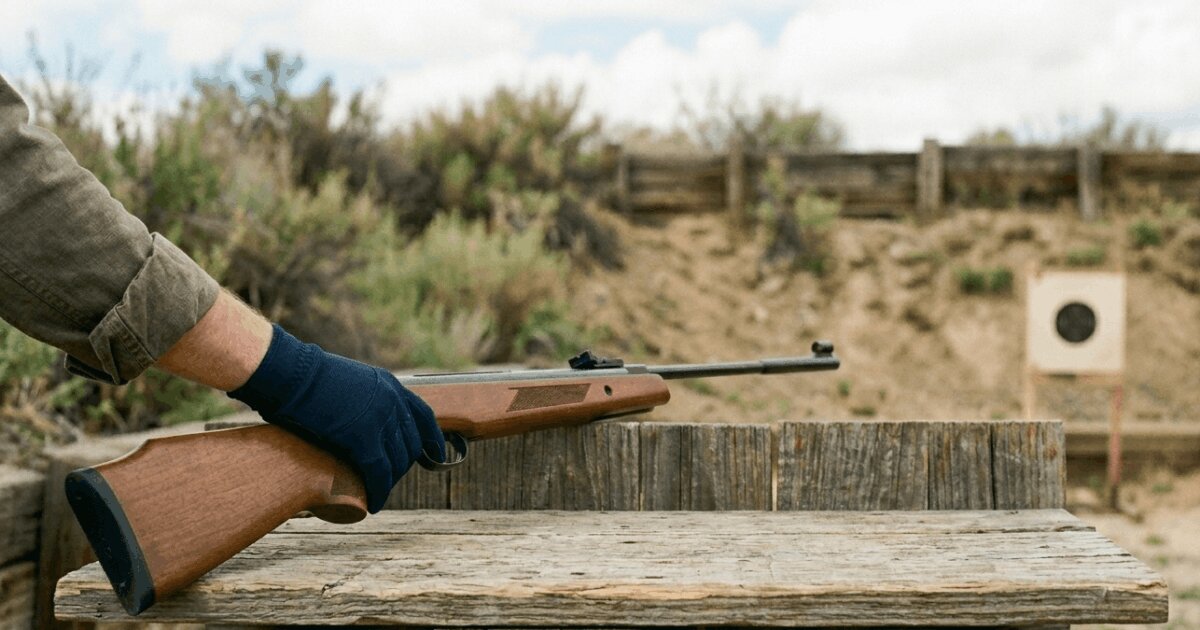
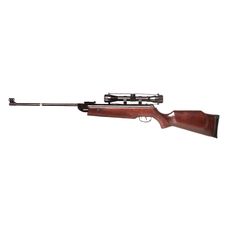
- Standard mechanical air rifles – these include break-barrel air rifles and air rifles cocked by an underlever or side lever. They feature simple construction, affordable prices, and easy maintenance or repair in case of failure. A disadvantage may be higher noise and stronger recoil. A typical example is Hämmerli Hunter Force 750 Combo.
- Air rifles powered by CO2 cartridges – cartridges are inserted to provide the energy for the shot, so they do not need to be mechanically cocked, and some models may be equipped with a magazine. Their construction is more complex, with valves and seals that will likely need replacement over time. However, they are quieter and have almost no recoil. A typical example is Crosman 1077.
- Pump-action (PCA) air rifles – they obtain energy for the shot by mechanically pumping air, for example using a movable forearm. The disadvantage is that to achieve full power, you may need to pump it manually 6 to 10 times. The reward is a relatively quiet shot with almost no recoil. A typical example is Crosman 760B.
- PCP air rifles – equipped with their own air reservoir, which needs to be filled from an external source such as a hand pump, compressor, or pressure tank. They are characterized by extreme accuracy, more complex construction, and a higher price compared to the types mentioned above.
Air rifles can also be divided into:
- Single-shot (without a magazine) – simpler construction, ammunition is inserted one by one, usually directly into the barrel.
- Multi-shot (with a magazine) – equipped with a magazine that allows multiple quick shots in succession.
Multi-shot rifles with a magazine can be divided by firing mode into:
- Repeater – the shot is usually triggered by reloading with a bolt handle, which moves or rotates the magazine each time to prepare the next shot.
- Semi-auto – the shot is fired simply by pulling the trigger, and the magazine automatically moves or rotates (e.g. UX Canex).
- Full-auto – a single trigger pull results in multiple shots fired in succession (e.g. Legends MP40).
The most common calibers of air rifles:
- Caliber 4.5 mm (.177)
- Caliber 5.5 mm (.22)
- Caliber 6.35 mm (.25)
- Caliber 7.62 mm (.30)
- Caliber 9 mm (.35)
Within the limit of freely available air rifles up to 17 Joules (in Slovakia), only calibers 4.5 mm or 5.5 mm make sense. Larger calibers only make sense if the air rifles have higher muzzle energy than 17 Joules.
If you want to shoot at longer distances, we recommend caliber 4.5 mm. If you prefer shooting at shorter distances, you can also choose caliber 5.5 mm. Remember that a larger caliber does not automatically mean greater power! The important factor is the muzzle energy measured in Joules.
Air rifles by type of ammunition:
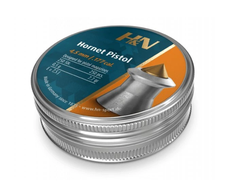
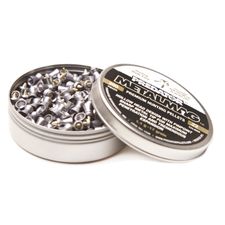
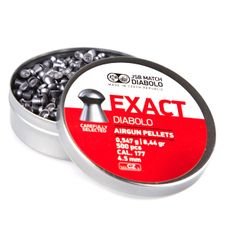
- Diabolo pellets – air rifles shooting pellets are characterized by better accuracy, as their barrels are rifled, which gives the pellet the required ballistic properties. They are suitable for target shooting.
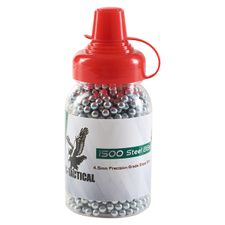
- Steel BBs – air rifles shooting steel BBs are less accurate because they do not have rifled barrels, making them more suitable for targets such as beverage cans at relatively short distances of up to approx. 15 m (e.g. Marlin Lever Action).
SHORT AIR GUNS
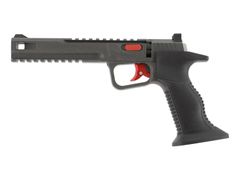
Short air guns are most often in the form of pistols or revolvers. However, there are also atypical models whose length lies somewhere between rifles and pistols. Many models are licensed replicas of real pistols or revolvers (e.g. Glock, Walther, CZ, Dan Wesson, and others). They can be divided by operating principle into the following types:
- Mechanical short air guns – these include break-barrel pistols or manually cocked air pistols, where the slide must be cocked manually before each shot. They feature simple construction, affordable prices, and easy maintenance or repair. A disadvantage may be higher noise and stronger recoil. A typical example is Daisy Powerline 340 or Ruger Mark IV.
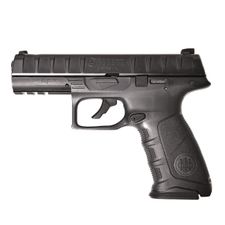
- CO2-powered short air guns – cartridges provide the energy for the shot, so no mechanical cocking is needed, and some models may include a magazine. Their construction is more complex, with valves and seals that may need replacement over time. However, they are quieter and have almost no recoil. A typical example is Beretta APX.
- Pump-action (PCA) short air guns – they obtain energy for the shot by mechanically pumping air. The disadvantage is the need for multiple pumps to reach full power. The benefit is a relatively quiet shot with almost no recoil and decent performance. Popular examples include Crosman 1377 or Zoraki HP-01.
- PCP short air guns – equipped with their own air reservoir, which must be filled from an external source. They offer extreme accuracy but have a more complex design and higher price.
Short air guns can also be divided into:
- Single-shot (without a magazine) – simpler construction, ammunition is inserted one by one.
- Multi-shot (with a magazine) – equipped with a magazine for multiple shots.
Short air guns with a magazine can be divided by firing mode into:
- Repeater – the shot is triggered by reloading with a bolt/lever (e.g. Diana Airbug).
- Semi-auto – the shot is fired by pulling the trigger, and the magazine moves automatically (e.g. UX Expert).
- Full-auto – one trigger pull results in multiple shots (e.g. Crosman PFAM9B).
The most common calibers of short air guns:
- Caliber 4.5 mm (.177)
- Caliber 5.5 mm (.22)
Manual, CO2, or pump-action short air guns are usually tuned to a power of 3 to 10 Joules, so larger calibers would not make sense in terms of performance. Larger calibers are typically found only in high-powered PCP short air guns, which require a firearms license in Slovakia (over 17 Joules).
Short air guns by type of ammunition:
- Diabolo pellets – short air guns shooting pellets are more accurate due to rifled barrels, making them suitable for target shooting (e.g. Glock 17 or Langley Pro Sniper).
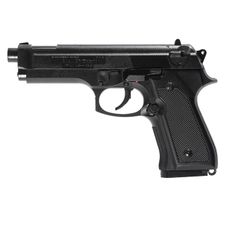
- Steel BBs – less accurate due to smooth barrels, suitable for short-range targets (e.g. Beretta Elite II).
WHAT WILL I NEED FOR AN AIR GUN?
Do not forget to consider the following accessories and equipment:
- Appropriate ammunition – steel BBs / pellets of the correct caliber.
- Improved aiming – red dot sight / scope.
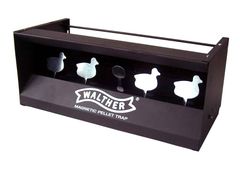
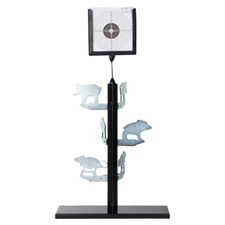
- Paper targets or metal targets and pellet traps.
- Suitable oil for maintenance and a cleaning kit.
- Transport case or plastic case.
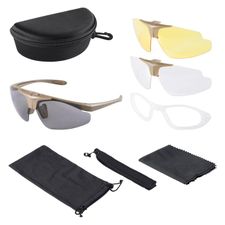
- Protective glasses.
- If you chose a CO2 gun, do not forget a sufficient number of cartridges.
If you are unsure about the correct choice of accessories and their compatibility with your selected air gun, feel free to contact us and we will advise you.
Availability
Currently unavailable
In Stock: 17
Availability: in stock
Availability
Currently unavailable
In Stock: 2
Availability: in stock
Availability
Currently unavailable
In Stock: 3
Availability: in stock
Availability
Currently unavailable
In Stock: 7
Availability: in stock
Availability
Currently unavailable
In Stock: 4
Availability: in stock
Availability
Currently unavailable
In Stock: 2
Availability: in stock
Availability
Currently unavailable
In Stock: 1
Availability: in stock
Availability
Currently unavailable
In Stock: 0
Availability: temporarily unavailable
T4E MARKERS – AIR GUNS OR PAINTBALL?
T4E brand markers that shoot rubber, pepper, or marking projectiles are also categorized among air guns in our offer. This is because they are essentially air-powered, as the energy for the shot is provided by compressed gas – carbon dioxide stored in a cartridge. They are also referred to by English terms such as Defense-Training Markers, Markers, or MagFed Paintball.
Frequently Asked Questions (FAQ)
Which air guns can I buy in Slovakia without a firearms license?
If you do not have a firearms license, you can acquire and own an air gun with a power of up to 17 Joules from the age of 18 in Slovakia.
What is a PCA air gun?
PCA (Pre Charged Air) is an air gun whose shooting energy is provided by compressed air that you pump using an integrated pump (e.g. by moving the forearm).
How does a break-barrel air gun work?
It is a mechanical air gun that is cocked by breaking the barrel, which compresses a spring. When the trigger is pulled, the spring is released and expands rapidly, pushing a piston that creates air pressure on the pellet, firing it from the barrel.
Which air gun brands offer quality and reliability at a reasonable price?
These are definitely brands such as GAMO, Crosman, Hämmerli, Umarex (UX), Action Sport Games (ASG), Diana, Atak Arms (Zoraki), B. O. Manufacture.
What accuracy can I expect from an air rifle in 4.5 mm caliber with a power of around 16 Joules?
When using quality pellets (e.g. JSB brand), a good scope, and solid shooting skills, you can expect accuracy at a distance of approx. 30 m on a target measuring 14 × 14 cm.
Is a 4.5 mm or 5.5 mm air rifle with 16 Joules better for target shooting?
It depends on the intended use. For accurate shooting at 20–30 m, we recommend 4.5 mm, as the pellet is lighter and travels faster. For shorter distances (up to 20 m), 5.5 mm can also be a good choice.
Is a 4.5 mm or 5.5 mm air rifle with 16 Joules better for pest control (e.g. rats)?
For shooting pests at distances up to 20 m, we recommend 5.5 mm. For longer distances, 4.5 mm is recommended.
What affects the accuracy of shooting with an air gun?
Accuracy is influenced by the quality and characteristics of the gun itself, the shooter’s skills, the quality of the pellets, and for longer distances, also the quality of the scope.
What does the designation .177 or .22 mean?
It is the caliber designation in Anglo-American inches ("). Caliber 0.177" = 4.5 mm and caliber 0.22" = 5.5 mm.
Can I keep a CO2 cartridge installed in my air gun permanently?
No, it is generally not recommended. A cartridge left under pressure for a long time negatively affects the valve and seals, which may shorten their lifespan and eventually cause CO2 leakage. Install the cartridge before shooting, use the gun, and store it without the cartridge afterward.
Automatically generated translation























 Riflescope
 Binoculars
 Scope mounts and rings
 Reflex Sights
 Crossbow scope






Add new comment
Add reply to comment: